When the Model Marks the Book, Who Meant to Deceive?
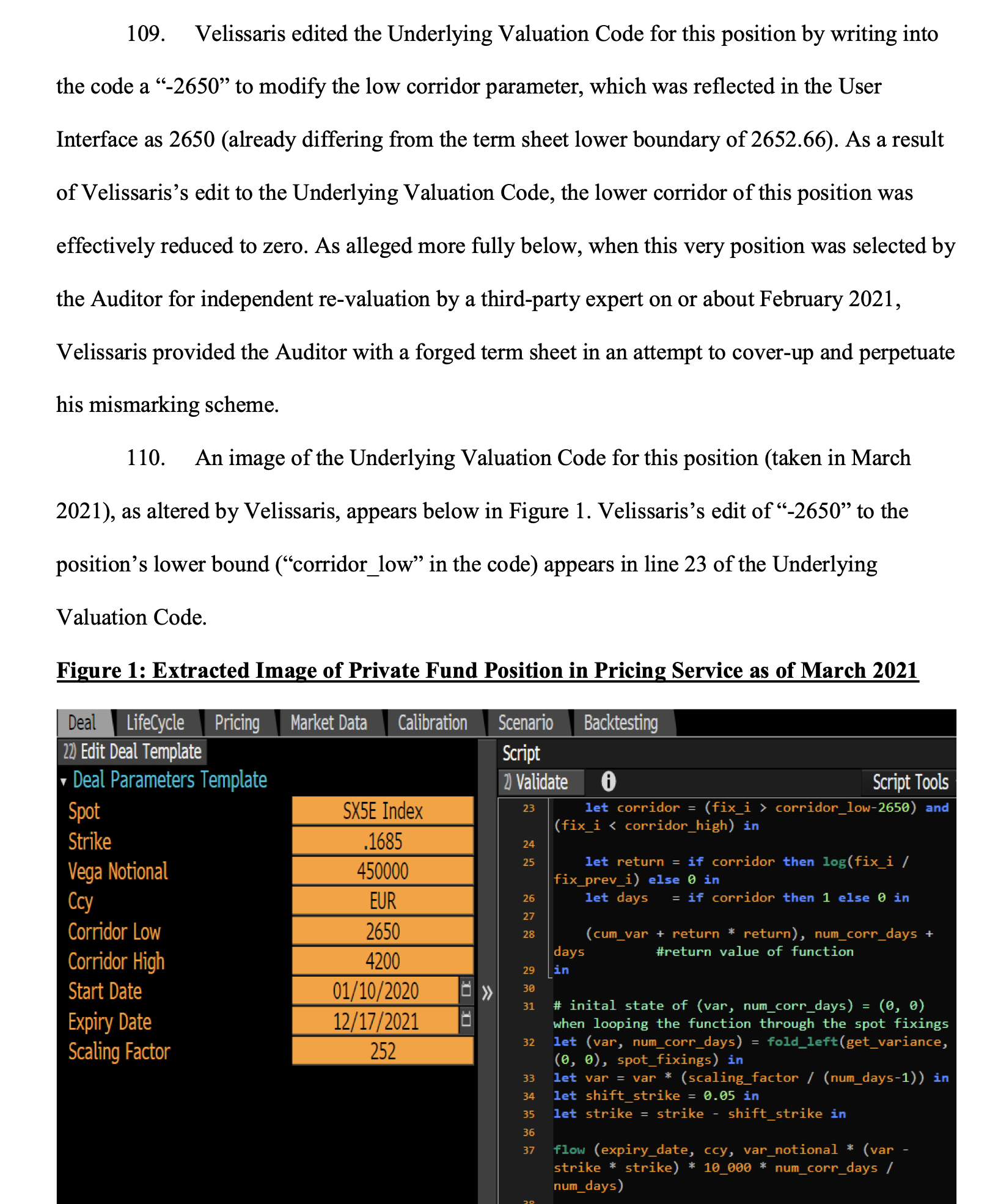
The heaviest valuation-fraud sentence of the decade came down to a few keystrokes. James Velissaris, the founder of Infinity Q, ran a $1.7 billion mutual fund whose exotic derivatives were valued by a third-party pricing service, which is precisely what his marketing materials promised investors: independent, model-based, arms-length valuation. What the marketing did not mention, according to the government, was that Velissaris had secret access to the pricing models themselves, and altered them, in some instances so crudely that the same instrument was valued inconsistently with its own contractual terms. The models said what he told them to say. When the fund collapsed in 2021, the gap between the models and reality ran to hundreds of millions of dollars. He pleaded guilty and received fifteen years.
One detail matters for anyone thinking about the next decade of investment fraud: Velissaris was convictable because code changes leave a record. A manual adjustment typed into a valuation model is either there or it is not. It can be compared against the vendor's original version, with timestamps showing who changed what and when. Prosecutors did not need to argue about whether his marks were honest opinions, the way courts must in most valuation cases. The dishonesty was written down.
Marking Fraud Has Been a Manual Crime
Every significant mismarking case in the modern record is the story of a human hand touching a number. Velissaris typed a parameter into valuation code. At Allianz, prosecutors alleged, portfolio managers manually altered risk reports before sending them to clients, in one instance changing a loss figure by simply deleting a digit. The SEC's mismarking docket of the 2010s was built on corrupted broker quotes: quotes the SEC alleged were obtained through a secret trades-for-quotes arrangement in its case against Premium Point Investments, quotes the agency called sham in its case against Visium. And in a pending class action over the collapsed Wildermuth Fund, a registered fund that held private company debt and equity, the complaint alleges the fund's valuation committees "continuously and repeatedly approved quarterly valuations without sufficient, reliable evidence to support them" while the portfolio companies deteriorated; after the founders resigned, the complaint alleges, a successor valuation firm cut the fund's investment values by 63.6 percent from their March 2022 marks.
The law's machinery for these cases is calibrated to that world. Fraud requires scienter, an intent to deceive, and intent is proven from the record the hand leaves behind: the edited code, the deleted digit, the quote solicited from a cooperative broker, the committee minutes approving a number nobody could support. The record is what separates the fifteen-year sentence from the dismissed complaint.
The Hands Are Leaving the Process
That world is ending, not hypothetically but as a matter of current vendor practice. Bloomberg states that BVAL, its evaluated pricing service, runs its data through algorithms that employ machine learning; its newer front-office product is built around a machine learning model that consumes billions of market data points. In 2025, S&P Global began integrating MarketAxess CP+, an AI-powered bond pricing tool that updates as often as every fifteen seconds, into the evaluated bond prices that feed fund NAVs. In private markets, where the marks are softest, Houlihan Lokey, which describes itself as valuation provider to more than 35 business development companies and direct lending funds spanning over $600 billion of assets, now markets an end-to-end valuation platform powered by AI. And 73 Strings, an AI valuation platform for private equity and private credit, raised $55 million in early 2025 in a round led by Goldman Sachs's growth equity arm, with Blackstone, Golub Capital, Hamilton Lane, and Fidelity International's venture arm participating. Note who is writing those checks: the machinery that values private assets is being funded by the managers whose assets it will value.
The Absolution Strategy
Here is the defense the next decade will produce. A manager adopts a machine-learned valuation system, points to its sophistication and its vendor pedigree, and when the marks turn out to have been wrong, says: the model did it. No human set that number. No human believed anything about it at all.
The strategy has real doctrinal footing, which is what makes it dangerous. Valuation statements are treated as opinions, actionable only if the speaker did not honestly believe them, and a model has no beliefs to examine. Worse, a manager who wants a learned model to flatter the portfolio never needs to type "-2650" anywhere. He curates the training data. He selects which comparable transactions the model learns from and which are excluded as outliers. He chooses the lookback windows, the validation benchmarks, and which of a dozen backtested variants goes into production. Each choice is defensible on its own; only the combination is dishonest, and the combination is not written down anywhere. The absolution strategy is the deliberate version of this drift: move the marking authority into the machine precisely because the machine cannot be cross-examined.
How the Law Will Evolve
The law will not accept this, and the outline of its answer is already visible in three moves.
First, delegation to a machine will fail as a defense, because the rules already assign every model to a human. For registered funds and business development companies, SEC Rule 2a-5 makes fair value a board responsibility and lets the board designate a valuation designee, almost always the adviser, which must then select, apply, and periodically test its fair value methodologies and oversee any pricing services it uses, with the supporting documentation preserved under a companion recordkeeping rule. A model is a methodology, not an officer of the fund. Adopting it, feeding it, and leaving it in production are human decisions, and the pleading template already exists: the Wildermuth complaint attacks committees that allegedly approved quarterly valuations "without sufficient, reliable evidence to support them." Substitute a model for the committee and the sentence works unchanged. The manager who signs off on machine output he never tested will be pleaded against exactly the way managers who rubber-stamped committee output are pleaded against today.
Second, the fight will relocate from the number to the description of the process, because that is where the falsifiable statements live. This move is further along than most managers realize. The SEC has already sanctioned two of the largest evaluated-pricing vendors over prices that were sometimes just one broker's number: ICE Data Pricing paid $8 million in December 2020 for delivering single-broker-quote prices without controls adequate to ensure they reflected value, and Bloomberg paid $5 million in January 2023 for delivering prices based on a single input while its disclosed methodologies described something more sophisticated. In March 2024 the agency brought its first AI-washing cases against two advisers that overstated their use of artificial intelligence. And in pending private litigation over a collapsed municipal bond fund, the plaintiffs' central theory is not that the marks were dishonest opinions but that the fund described a methodology using market-based inputs while the actual market transactions were allegedly excluded. Whether a position is worth 98 or 60 is an opinion. Whether your model trains on the data you said it trains on, whether the validation was independent, whether anyone can override the output: those are facts, and facts can be proven false. Model-governance representations will become to the 2030s what hedge strike distances were to the Allianz prosecutions.
Third, opacity itself will become the culpable act. There is a paradox buried in the vendor landscape: the governed AI platforms generate more evidence than the spreadsheets they replace, not less. 73 Strings markets assumption-level audit trails and logged manual adjustments as core compliance features. On a platform like that, every override carries a user, a timestamp, and a before-and-after, which is precisely the kind of record that convicted Velissaris; the pricing service had retained his entries. A manager seeking genuine unaccountability cannot find it in a governed platform. He can find it only by choosing systems that keep no reconstructable record: the in-house model living in an unversioned notebook, the vendor black box whose training data no subscriber ever sees. Expect courts and regulators to treat that choice the way they came to treat firms doing business over messaging apps that preserved no records: selecting the channel that leaves no record is itself the offense, and the missing record gets construed against the party who chose the channel. The recordkeeping rule already requires documentation supporting each fair value determination; a mark that cannot be reconstructed is a violation before anyone reaches the question of fraud. The evidentiary vacuum the absolution strategy depends on will be recharacterized as the crime.
Two Things the Models Cannot Fake
For investors, and for the advisers who owe them explanations, the practical guidance survives the technology shift unchanged, because two gauges sit outside any model's reach.
The first is cash. A model can smooth a mark, a manager can curate the data behind it, but cash received is an arithmetic fact. A fund whose distributions persistently exceed the cash its assets actually generate is making a promise its portfolio is not keeping, whether the gap is papered over by payment-in-kind accounting, by stale marks, or by a learned model with tastefully selected comparables. The current litigation against business development companies whose managers collected fees on interest that was never paid in cash is this exact principle in action.
The second is the shape of the return stream itself. As the companion piece to this article documents, fifteen years of volatility-fund litigation reduces to one sentence: nobody sues the fund that loses money honestly. Returns that stay smooth through turbulent markets are, in the historical record, where risk hides and sometimes where fraud does. Machine-learned valuation will make that smoothness cheaper to manufacture. But the law is not standing still: the duty to test the model, the truth of the process descriptions, and the record of who touched the output are becoming the new points of attack. The mismarking case of the last decade asked what the manager typed. The mismarking case of the next decade will ask what the manager built, what he claimed about it, and why the records are missing. When the model marks the book, read the bank statement, and then read the model-governance section of the prospectus as carefully as the performance table.
The companion piece: Nobody Sues the Fund That Loses Money Honestly.
David Brunk is a civil litigation attorney. newmanbrunk.com · david@newmanbrunk.com
The allegations described here are taken from the filing and remain unproven; no responsive pleading is reflected in the source document.
David Brunk is a civil litigation attorney. He can be reached at david@newmanbrunk.com.
Questions about this topic: david@newmanbrunk.com